


Introduction
India’s National Flag, popularly known as the Tiranga, is a symbol of freedom, unity, and national pride. It reflects the sacrifices of countless freedom fighters and the democratic values of the nation. Every year, National Flag Adoption Day commemorates the historic adoption of the Indian National Flag by the Constituent Assembly.
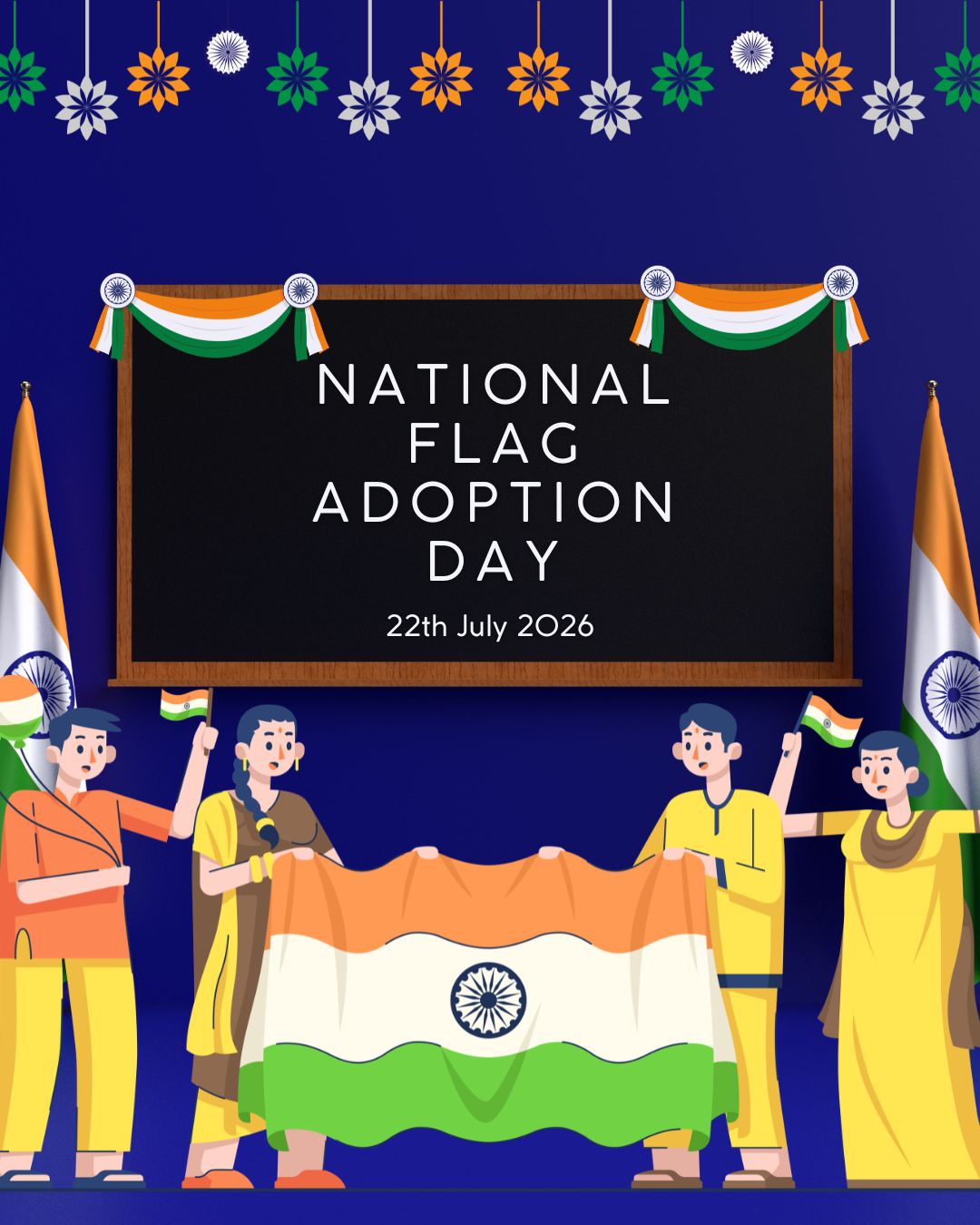
National Flag Adoption Day 2026 will be observed on Wednesday, 22 July 2026. On this day in 1947, the Constituent Assembly officially adopted the Tiranga as the National Flag of India, just weeks before Independence on 15 August 1947.
The day encourages citizens to learn about the flag’s history, symbolism, and importance while honoring one of India’s most respected national symbols.
When Is National Flag Adoption Day 2026?
National Flag Adoption Day 2026 will be observed on Wednesday, 22 July 2026.
The date marks 22 July 1947, when the Constituent Assembly of India officially adopted the Tiranga as the National Flag. It was adopted 24 days before India’s Independence, making it a landmark moment in the country’s history.
What Is National Flag Adoption Day?
National Flag Adoption Day is an annual observance that celebrates the adoption of the Indian National Flag by the Constituent Assembly in 1947.
The day highlights the Tiranga as a symbol of India’s sovereignty, unity, and democratic values. It also encourages citizens to understand the Flag Code of India and display the national flag with dignity and respect.
History of National Flag Adoption Day
The origins of the Indian National Flag trace back through decades of the freedom struggle. Here is the timeline of how it evolved:
- 1921: Mahatma Gandhi first proposed a flag designed by Pingali Venkayya, which featured two bands (red for Hindus, green for Muslims) with a spinning wheel (charkha) in the center to represent self-reliance.
- 1931: A landmark resolution was passed to adopt a tricolor (Saffron, White, and Green) with the spinning wheel in the center. The colors were redefined to have no communal significance.
- July 22, 1947: The Constituent Assembly officially adopted this tricolor as the National Flag of India. To ensure the flag looked identical from both sides and to reflect the country’s heritage, Jawaharlal Nehru proposed replacing the spinning wheel with the Ashoka Chakra (the wheel of the law from the 3rd-century BC Lion Capital of Ashoka).
- August 15, 1947: The adopted flag was officially hoisted, proudly symbolizing the sovereign, democratic values of the newly independent nation.
Why Is National Flag Adoption Day Celebrated?
National Flag Adoption Day honors the historic adoption of the Tiranga and promotes respect for India’s national flag.
The observance aims to:
- Celebrate the adoption of the Indian National Flag.
- Honor the sacrifices of freedom fighters.
- Promote patriotism and national unity.
- Educate young generations about the Tiranga.
- Encourage respect for the Flag Code of India.
It reminds every Indian that the Tiranga represents the nation’s shared history, values, and aspirations.
Why the Tiranga Is a Symbol of National Pride
The Tiranga is one of India’s most cherished national symbols. It proudly flies during national celebrations, international events, and important government ceremonies.
The flag represents:
- Freedom and Independence
- Unity in Diversity
- Peace and Truth
- Courage and Sacrifice
- Progress and Prosperity
- National Pride
It inspires millions of Indians to uphold the values of the nation and work towards a stronger future.
The Significance of the Indian National Flag (Tiranga)
The Tiranga is more than India’s national flag—it is a symbol of the country’s identity, unity, and democratic values. It represents the courage of freedom fighters, the strength of the nation, and the hopes of over a billion Indians.
Whether displayed on government buildings, schools, or during national celebrations, the flag reminds every citizen of their duty to uphold the ideals of the nation.
What Do the Three Colors of the Tiranga Represent?
Each color of the Indian National Flag has a special meaning:
🟧 Saffron
The top saffron band represents courage, sacrifice, and selflessness. It reflects the spirit of dedication shown by those who fought for India’s freedom.
⚪ White
The white band symbolizes peace, truth, and honesty. It reminds citizens to follow the path of justice and harmony.
🟩 Green
The green band stands for faith, prosperity, and growth. It reflects India’s rich agricultural heritage and hopes for a sustainable future.
What Does the Ashoka Chakra Represent?
At the center of the Tiranga is the navy-blue Ashoka Chakra, featuring 24 spokes.
The Ashoka Chakra symbolizes:
- Progress and continuous movement
- Justice and righteousness (Dharma)
- Equality and peace
- The importance of moving the nation forward
Inspired by the Lion Capital of Ashoka at Sarnath, the Chakra reminds citizens that growth comes through action and responsibility.
Who Designed the Indian National Flag?
The Indian National Flag was designed by Pingali Venkayya, a freedom fighter and scholar from present-day Andhra Pradesh.
His design was accepted by the Constituent Assembly on 22 July 1947 with the Ashoka Chakra replacing the spinning wheel (Charkha). His contribution remains one of the most significant chapters in India’s history.
Flag Code of India: Important Rules to Remember
The Flag Code of India lays down guidelines for displaying and handling the national flag respectfully.
Some important rules include:
- Always display the Tiranga with respect and dignity.
- The saffron band must always remain at the top.
- The flag should not touch the ground or water.
- A damaged or torn flag should never be displayed.
- The national flag should not be used as clothing, decoration, or packaging material.
- Dispose of worn-out flags respectfully according to the Flag Code.
Following these rules helps preserve the dignity and honor of India’s national flag.
How Is National Flag Adoption Day Celebrated?
Although National Flag Adoption Day is not a public holiday, it is observed across India through educational and patriotic activities. Schools, colleges, government institutions, and social organizations use the occasion to spread awareness about the Tiranga and its importance.
Common celebrations include:
- Flag-hoisting ceremonies
- Speeches on the history of the Tiranga
- Essay, quiz, and drawing competitions
- Patriotic songs and cultural programs
- Awareness campaigns on the Flag Code of India
- Social media posts promoting respect for the national flag
These activities help inspire patriotism and educate young generations about India’s national heritage.
Har Ghar Tiranga Campaign
The Har Ghar Tiranga campaign, launched under the Azadi Ka Amrit Mahotsav, encourages citizens to proudly display the Tiranga at their homes.
Although mainly organized around Independence Day, the campaign has strengthened public awareness about the national flag and inspired people to learn more about its history, symbolism, and proper usage.
Interesting Facts About the Indian National Flag
Here are some fascinating facts about the Tiranga:
- The Designer: The flag was designed by Indian freedom fighter Pingali Venkayya from Andhra Pradesh.
- Official Fabric: Legally, the flag must be made exclusively of Khadi—a hand-spun cloth popularized by Mahatma Gandhi.
- The Sole Manufacturer: The Karnataka Khadi Gramodyoga Samyukta Sangha in Hubli is the only authorized unit in India that can manufacture and supply the national flag.
- Strict Ratios: The flag must strictly adhere to a width-to-length ratio of 2:3.
- Meaning of Saffron: The top saffron band symbolizes courage, sacrifice, and the spirit of renunciation.
- Meaning of White: The middle white band represents peace, truth, and purity.
- Meaning of Green: The bottom green band signifies faith, fertility, and prosperity.
- The 24 Spokes: The Ashoka Chakra, adopted from the Lion Capital of Ashoka at Sarnath, has 24 spokes representing the laws of Dharma.
- Space & Everest: The Tiranga has been carried to the summit of Mount Everest and has even traveled into outer space.
- The Flag Code: According to the Flag Code of India, the flag cannot be used for personal clothing, must be hoisted only during daylight hours, and should never touch the ground.
National Flag Adoption Day 2026 Quotes
“The Tiranga is not just a flag—it is the pride, courage, and spirit of every Indian.”
“Respect the Tiranga, honor our history, and celebrate the unity of India.”
“The Indian National Flag reminds us that freedom comes with responsibility.”
“Every wave of the Tiranga tells the story of India’s courage and sacrifice.”
“Let the Tiranga inspire us to build a stronger, united, and prosperous India.”
National Flag Adoption Day 2026 Wishes
- 🇮🇳 Happy National Flag Adoption Day! Let us proudly honor our beloved Tiranga.
- 🇮🇳 May the Indian National Flag always inspire unity, peace, and patriotism.
- 🇮🇳 Celebrate the spirit of freedom by respecting and honoring the Tiranga.
- 🇮🇳 Let us remember the sacrifices behind our national flag and work for a better India.
- 🇮🇳 Wishing everyone a meaningful National Flag Adoption Day 2026!
Conclusion
National Flag Adoption Day 2026 is a meaningful occasion that celebrates one of India’s most cherished national symbols—the Tiranga. Observed every year on 22 July, it marks the historic adoption of the Indian National Flag by the Constituent Assembly in 1947, just weeks before Independence.
The Tiranga represents freedom, unity, peace, courage, and progress. By understanding its history and respecting the Flag Code of India, every citizen can help preserve the dignity of the national flag.
As we observe National Flag Adoption Day 2026, let us honor the sacrifices of our freedom fighters, celebrate the values that unite us, and proudly uphold the spirit of the Tiranga for generations to come.
Frequently Asked Questions (FAQs)
1 When is National Flag Adoption Day 2026?
National Flag Adoption Day 2026 will be observed on Wednesday, 22 July 2026.
2. Why is National Flag Adoption Day celebrated?
The day commemorates the adoption of the Indian National Flag (Tiranga) by the Constituent Assembly on 22 July 1947 and promotes respect for India’s national symbol.
3. Who designed the Indian National Flag?
The Indian National Flag was designed by Pingali Venkayya, a freedom fighter and flag designer. The final design with the Ashoka Chakra was adopted in 1947.
4. What do the three colors of the Tiranga represent?
Saffron: Courage and sacrifice
White: Peace and truth
Green: Faith, prosperity, and growth
5. What does the Ashoka Chakra symbolize?
The Ashoka Chakra, with its 24 spokes, represents dharma (righteousness), justice, progress, and continuous movement.
6. Is National Flag Adoption Day a public holiday in India?
No. National Flag Adoption Day is not a public holiday, but it is observed through educational and awareness activities across the country.
7. How can people celebrate National Flag Adoption Day?
People can celebrate by learning about the Tiranga’s history, participating in school or community programs, following the Flag Code of India, and displaying the national flag respectfully.